UV Flatbed Printing
UV flatbed printing on virtually any rigid substrate, full-colour plus white ink, no plates or screens, and short runs as cost-effective as long runs.
What is UV Flatbed Printing?
UV flatbed printing uses ultraviolet-curable inks jetted directly onto the substrate surface and cured instantly by UV lamps integrated into the print head carriage. The result is a hard, scratch-resistant print that adheres directly to the substrate without a carrier film or laminate. Because the process is entirely digital, no plates, no screens, no tooling, it is equally cost-effective for a single piece as it is for a production run, making it the go-to process for short runs, prototypes, and jobs with multiple variants.
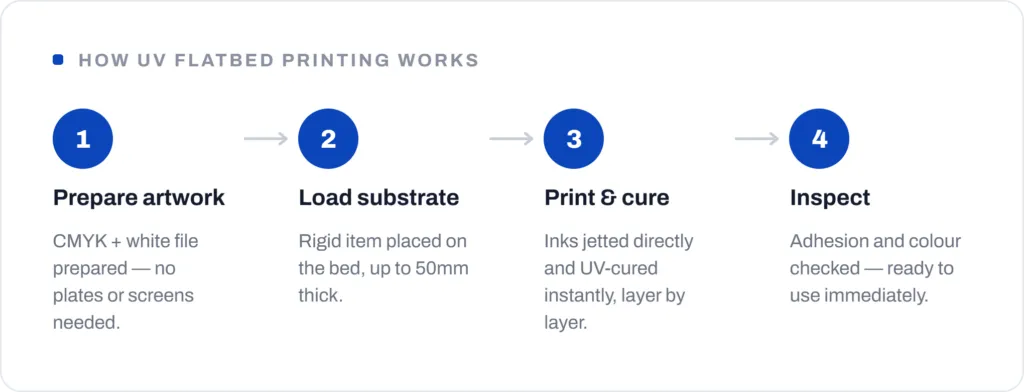
The flatbed design means the printer can accept virtually any rigid substrate up to the bed dimensions, including assembled objects and three-dimensional items up to 50mm in height. Substrates routinely printed include acrylic, aluminium, steel, PVC, polycarbonate, timber, glass, ceramic, and leather. CMYK plus white ink is standard, allowing full-colour printing on transparent and dark substrates. The white layer is printed first as an opaque base before the colour layers are applied on top.
UV flatbed printing is particularly well-suited to custom promotional items, bespoke signage, branded corporate gifts, product prototypes, and any application where the substrate shape or size prevents the use of label-based decoration. We can print direct to finished acrylic displays, metal panels, timber plaques, and custom fabrications, eliminating the need for a separate label application step and providing a more integrated, premium-looking result.
Best for Printing directly onto rigid substrates and finished objects where a label or carrier film is undesirable: custom promotional items, bespoke signage, branded corporate gifts, product prototypes and printing straight onto finished acrylic displays, metal panels and timber plaques. UV-curable ink is jetted onto the surface and cured instantly to a hard, scratch-resistant finish with no laminate needed. The flatbed accepts virtually any rigid substrate up to the bed size, including assembled and three-dimensional items up to 50mm thick, and CMYK plus white ink allows full-colour printing on transparent and dark substrates. Maximum bed dimensions for your piece are best confirmed with us.
When it's cost-effective Short runs, prototypes and multi-variant jobs, where it is genuinely as cost-effective for a single piece as for a production run because there is no plate, screen or tooling and therefore no setup cost. Variable designs cost nothing extra to switch between, and printing direct to the substrate removes the separate label-application step. For long runs of one fixed design on a flat substrate, screen printing may give a lower per-unit cost, so tell us about your job and we will advise on the most economical route.
Commonly used materials in uv flatbed printing are Acrylic, Aluminium Composite, Foam Board, PVC, Polycarbonate, Wood, Glass and Ceramic Tiles.
Why choose UV Flatbed Printing
Full colour on rigid substrates
CMYK plus white ink on virtually any flat surface up to 50mm thick, no separate media handling
No screens or plates
Digital workflow means no tooling cost for short runs, one-offs, or personalised pieces
Instant cure
UV-cured inks are hard and scratch-resistant immediately after printing, no waiting time or post-processing
Our work
Products we make with UV Flatbed Printing
Industries that use UV Flatbed Printing
Frequently asked questions
UV flatbed printing uses UV-curable inks jetted directly onto the substrate surface, then instantly cured by UV light. The printer accommodates rigid objects up to a set bed size, printing directly onto the surface without the need for heat or contact, making it suitable for delicate, textured, or uneven surfaces.
UV flatbed printing works on virtually any flat or near-flat surface: metals, acrylic, glass, wood, foam, PVC, ceramics, leather, and most plastics. Unlike screen printing, it does not require a separate screen for each colour, making it cost-effective for full-colour and short-run jobs.
UV-cured inks form a hard, scratch-resistant surface layer that adheres well to most substrates. Durability depends on the substrate and application environment. Indoor applications typically last 3–5 years; outdoor applications with UV-stable inks can achieve 2–3 years without significant fading.
Yes. UV flatbed printing achieves resolutions up to 1440dpi, producing photographic-quality output including gradients, photographs, and complex multi-colour artwork directly onto the substrate surface.
The flatbed accepts rigid sheets and assembled three-dimensional objects up to the bed dimensions and a set height clearance, so items thicker than a standard sheet can still be printed directly. Anything within that envelope can be printed without a carrier film or label.
Ready to start a UV Flatbed Printing job?
Attach your artwork or drawing and we'll quote the process, material and turnaround for your project.
Get a quote