Screen Printing
Thick-deposit screen printing for industrial nameplates, control panel graphics, and safety labels, bold colour, precise registration, and long service life.
What is Screen Printing?
Screen printing pushes ink through a mesh stencil onto the surface, laying down a much thicker ink film than any digital method. That thick deposit gives the graphics their punch: colours look richer and more opaque, and the marks resist abrasion, UV and chemical attack far better than digital equivalents. We have run screen presses for over 45 years and mix ink in-house for exact Pantone colour matching on any substrate.
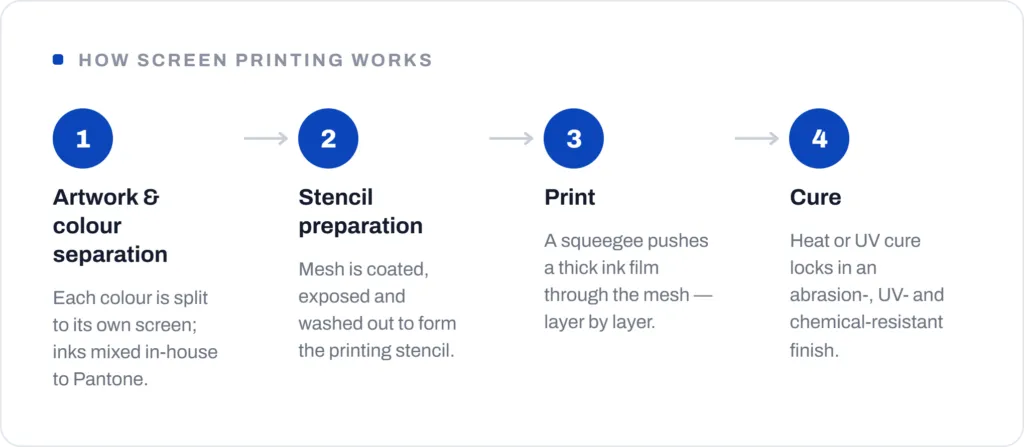
Best for Industrial nameplates, control-panel overlays, membrane switch graphics and safety labels that need colour accuracy and a long service life. We can lay multiple colour layers in sequence, including white underbases for dark or metallic substrates and clear protective topcoats for extra surface hardness, plus specialty inks such as two-part epoxies, UV-curable and heat-resistant systems for demanding environments.
When it’s cost-effective Medium to long runs, where the one-off screen cost per unit becomes negligible. For short runs or variable-data jobs we usually recommend digital label or UV flatbed printing instead, and we can combine the two (a screen-printed base with digitally applied variable data) when that gives the best result. Tell us about your job and we will advise on the most cost-effective process.
Commonly used materials in screen printing are Aluminium, Stainless Steel, Polycarbonate, Acrylic, Engraving Laminate (Gravoply And Traffolyte), Polyester, Vinyl and Fabric.
Why choose Screen Printing
Thick ink deposit
Bold, opaque colours with good UV and chemical resistance: colour performance exceeds most digital methods
Pantone colour matching
In-house ink mixing ensures exact brand colour reproduction to Pantone, RAL, or supplied sample
Volume efficiency
Per-unit cost drops significantly at higher quantities, the preferred method for large production runs
Our work
Products we make with Screen Printing
Frequently asked questions
Screen printing (silk screen printing) forces ink through a mesh stencil onto the substrate surface to produce coloured graphics, text, or logos. It works on flat and slightly curved surfaces including metals, plastics, glass, wood, fabric, and coated materials, making it versatile for both industrial and decorative applications.
Industrial screen printing using solvent-based or UV-cured inks produces marks that are resistant to abrasion, chemicals, and UV exposure when properly cured. For outdoor or harsh environment applications, additional clear coat protection can be applied. Engraving or etching is recommended where label survivability in extreme conditions is critical.
Screen printing involves a setup cost for producing the mesh stencil (screen), so it is most cost-effective at quantities of 50 units or more. Small runs are possible but per-unit cost will be higher. Digital printing methods are more economical for very short runs.
Yes. We mix inks to Pantone specification to reproduce exact brand colours. For multi-colour artwork, each colour requires a separate screen. Pricing is based on the number of colours in the design.
Screen printing itself lays down a fixed image, so it does not print unique data on each piece. Where you need both bold, durable screen-printed graphics and per-unit data, we can combine a screen-printed base with digitally applied variable text, barcodes, or serial numbers. Tell us the requirement and we will advise on the best combination of processes.
Ready to start a Screen Printing job?
Attach your artwork or drawing and we'll quote the process, material and turnaround for your project.
Get a quote