Laser Engraving
Permanent, tactile laser engraving that cannot be peeled, worn off, or chemically attacked, suitable for metals, acrylics, and most industrial substrates.
What is Laser Engraving?
Laser engraving removes material from the substrate surface to create a permanent, tactile mark. Unlike printing or labelling, an engraved mark cannot be peeled away, worn off, or chemically attacked. It is physically part of the material for the life of the product. At Million, we use CO2 and fibre laser systems to engrave metals, acrylics, engraving laminate (Gravoply and Traffolyte), timber, leather, and most engineered plastics to precise depths controlled entirely through software.
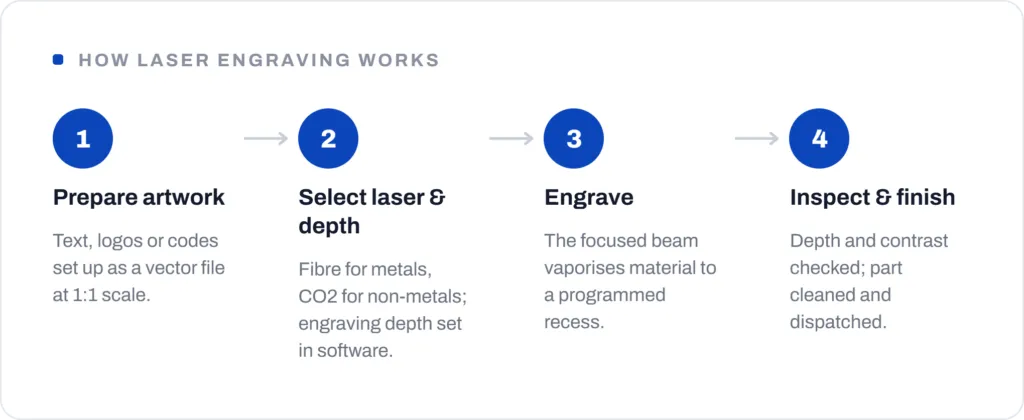
Engraving depth is fully programmable, from a fine surface texture through to a 0.5mm recess, and the same system that engraves text can also engrave barcodes, Data Matrix codes, logos, and photographic-quality images. On anodised aluminium and stainless steel, fibre laser engraving produces a high-contrast black or dark grey mark that is particularly well-suited to traceability and asset identification applications where scanner readability is required over the long term.
Laser engraving is the preferred method for any marking application where permanence is the primary requirement: equipment nameplates, serial number marking, electronic component marking, and architectural signage are all common uses. We work from your supplied artwork and can advise on the most appropriate laser system and settings for your material and application.
Best for Applications where the mark has to outlive the product and stay readable for its whole service life: equipment nameplates, serial numbers, electronic component marking and architectural signage. Because the mark is a physical recess cut into the material, it cannot be peeled, worn off or chemically attacked, and the same setup that cuts text will also render barcodes, Data Matrix codes, logos and photographic images. Fibre laser engraving gives high-contrast, scanner-readable marks on stainless steel and anodised aluminium, which suits traceability and asset-identification work. For your specific substrate, achievable depth and finish, ask us to advise on the right laser system and settings.
When it's cost-effective Any run size, because the process is fully digital with no screen, plate or hard tooling to pay off first. There is no per-job setup cost beyond programming, so a single part or a short run carries no penalty, and variable data such as unique serial numbers costs nothing extra to add. Consumable cost is minimal since nothing is deposited on the surface. For very large volumes of the same simple mark, a faster method such as laser etching or screen printing may bring the per-unit cost down further, so tell us about your quantity and we will advise on the best process.
Commonly used materials in laser engraving are Stainless Steel, Aluminium, Brass, Anodised Metals, Acrylic, Engraving Laminate (Gravoply And Traffolyte), Wood, Leather and Coated Glass.
Why choose Laser Engraving
Permanent marks
Engraved marks survive harsh chemicals, UV exposure, abrasion, and sustained high temperatures
Variable depth
From a light surface etch to a 0.5mm deep recess, programmed to specification for each job
No inks or consumables
Marking is purely thermal: no inks or pigments to fade, flake, or wear away
Our work
Products we make with Laser Engraving
Industries that use Laser Engraving
Frequently asked questions
Laser engraving uses a focused laser beam to remove material from the surface of a substrate, creating a permanent recessed mark. A fibre or CO2 laser is directed by CNC-controlled mirrors, vaporising material layer by layer to produce text, logos, barcodes, or graphics with high precision.
Laser engraving works on stainless steel, aluminium, brass, anodised metals, acrylic, wood, leather, rubber, glass, and coated surfaces. The laser type, fibre for metals, CO2 for non-metals, is selected based on the substrate material and required marking depth.
Laser engraving is one of the most permanent marking methods available. Because material is physically removed rather than applied, the mark cannot peel, fade, or be rubbed off. It withstands chemical exposure, abrasion, UV radiation, and extreme temperatures, making it ideal for industrial and outdoor applications.
There is no strict minimum order quantity for laser engraving at Million Advertising. We accommodate single prototypes through to large production runs. Setup costs are amortised over volume, so per-unit pricing improves significantly at higher quantities.
We engrave from your supplied artwork, ideally vector files (AI, EPS, PDF, or DXF) so text and logos stay crisp at any size. High-resolution raster images can be used for photographic or logo engraving. If you only have a printed sample or a rough layout, send it over and we can advise on redrawing it for production.
Ready to start a Laser Engraving job?
Attach your artwork or drawing and we'll quote the process, material and turnaround for your project.
Get a quote