
Rotary Engraving
Precision CNC rotary engraving for control panel legends, nameplates, and architectural signage, deep, tactile marks that last the life of the product.
What is Rotary Engraving?
CNC rotary engraving uses a spinning carbide or diamond-tipped cutter to physically remove material and create a recessed mark. Unlike laser processes, the cut produces a true mechanical recess with clean, defined walls, a characteristic that is essential for engraving laminate, where the top layer of the laminate must be fully removed to reveal the contrasting colour core beneath. At Million, rotary engraving is our primary process for control panel legends, switchboard labels, architectural name plates, and any application where a deep, tactile mark is required.
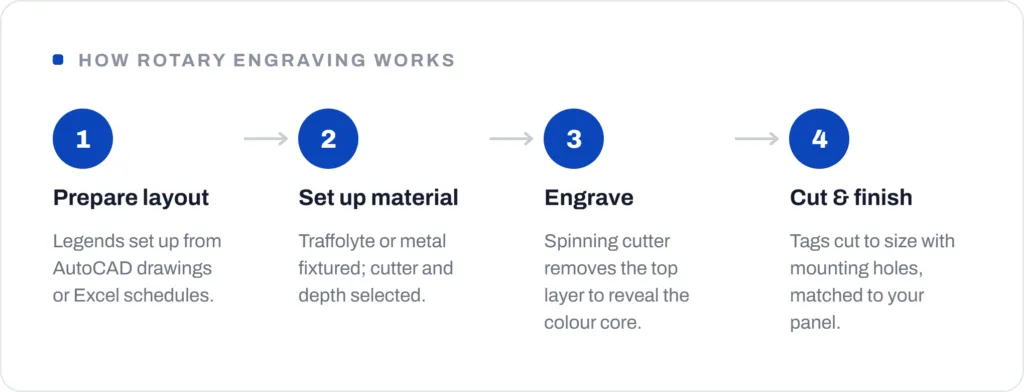
Traffolyte, a two-layer or multi-layer engraving laminate, is the industry standard material for control panel labelling across Singapore and the wider region, and we are among the most experienced Traffolyte engravers in the country. We produce individual legend tags from schedule drawings as well as complete panel sets for MCC rooms, DCS consoles, and process control systems, working directly from AutoCAD drawings or Excel schedules. The finished tags are supplied cut to size, with or without mounting holes, and matched to your panel layout drawing.
Beyond Traffolyte, CNC rotary engraving is effective on brass, aluminium, acrylic, and solid timber, materials used for architectural signage, room identification plates, and presentation items. The process produces marks that are genuinely permanent: unaffected by paint overspray, solvent cleaning, or abrasive maintenance, and still legible decades after installation.
Best for Deep, tactile, genuinely permanent marks, especially Traffolyte control-panel legends, switchboard labels, architectural nameplates and room-identification plates. The spinning cutter produces a true mechanical recess with clean walls, which is exactly what Traffolyte needs so the top laminate is fully removed to reveal the contrasting colour core. It also cuts brass, aluminium, acrylic and solid timber, and the marks are unaffected by paint overspray, solvent cleaning or abrasive maintenance and stay legible for decades. We produce individual legend tags and complete panel sets directly from AutoCAD drawings or Excel schedules, cut to size with or without mounting holes.
When it's cost-effective Small to medium quantities and one-off or made-to-schedule panel work, because it needs no screens, plates or tooling: each tag is cut straight from the drawing or schedule with no setup cost to pay off, so a single legend tag is economical to produce. Because it is a mechanical cut, engraving time scales with the amount of material removed, so very large volumes or very deep cuts take proportionally longer; for high-volume flat marking a laser method may be quicker. Send us your schedule or panel layout and we will advise.
Commonly used materials in rotary engraving are Engraving Laminate (Gravoply And Traffolyte), Aluminium, Brass, Stainless Steel, Acrylic and Timber.
Why choose Rotary Engraving
Deep, tactile marks
Mechanically cut depth provides a tactile feel that laser surface marks cannot replicate
Traffolyte expertise
Decades of experience with layered laminate materials for control panels, switchboards, and valve identification
Wide material range
Works on Traffolyte, aluminium, brass, stainless steel, acrylic, and timber
Our work
Products we make with Rotary Engraving
Frequently asked questions
Rotary engraving uses a spinning cutting tool (cutter or diamond drag) to mechanically cut marks into the substrate surface. Unlike laser engraving, it physically removes material through mechanical cutting rather than vaporisation. Rotary engraving excels at deep, tactile marks and is preferred for Traffolyte laminate nameplates and multi-layer materials where contrasting layers are exposed.
Rotary engraving works on Traffolyte (two-layer engraving laminate), aluminium, brass, stainless steel, acrylic, wood, and most plastics. It is the preferred method for Traffolyte engraving, the standard material for control panel labels, switchboard nameplates, and industrial identification.
Traffolyte is a two-layer engraving laminate material, typically a coloured surface over a contrasting core, used for engraved industrial nameplates, control panel labels, and equipment identification. When rotary engraved, the surface layer is removed to reveal the contrasting core colour, producing durable, legible text that cannot be obscured by paint or cleaning.
Rotary engraved nameplates in Traffolyte or anodised aluminium are designed for the lifetime of the equipment they identify, typically 20–30 years in industrial environments. The mark is mechanical and permanent; it cannot peel, fade, or be removed by solvents, cleaning agents, or normal abrasion.
Traffolyte is a layered laminate, so the engraved text shows the contrasting core colour beneath the surface, for example white text on a black plate or black text on a white plate. A range of surface and core colour combinations is available for colour-coding by function or voltage.
Ready to start a Rotary Engraving job?
Attach your artwork or drawing and we'll quote the process, material and turnaround for your project.
Get a quote