Laser Cutting
Precise laser cutting for metals, acrylics, and engineered materials. Submit your design file and we handle the rest. No minimum order quantity.
What is Laser Cutting?
Laser cutting uses a focused, high-energy beam to cut through sheet materials with a level of precision and repeatability that mechanical cutting methods cannot match. At Million, we operate both CO2 and fibre laser systems, allowing us to cut a wide range of materials, from mild steel, stainless steel, and aluminium to acrylic, polycarbonate, MDF, and rubber, all from the same DXF or vector artwork file with no tooling required.
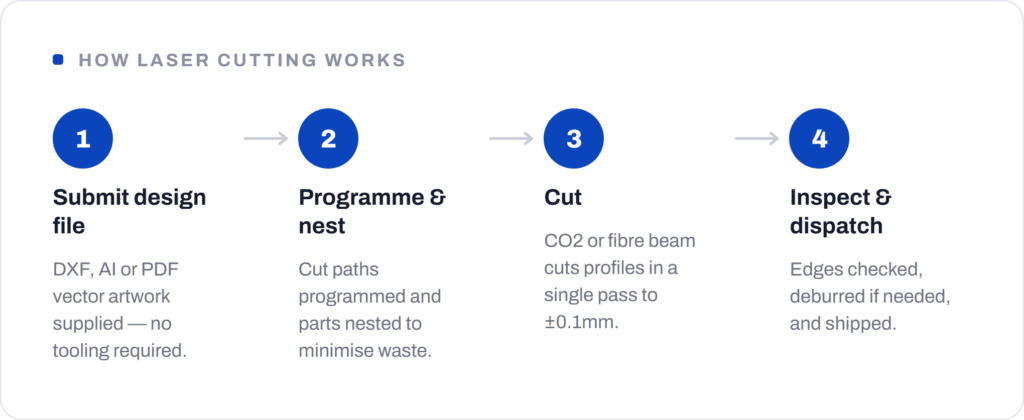
Because the process is entirely digital, there is no hard tooling to make, no setup cost beyond programming, and no minimum run size. A single custom part costs no more per unit to produce than a batch of a thousand. Tolerances of ±0.1mm are routinely achieved on flat sheet work, and intricate profiles, including fine lettering, close-pitch perforations, and complex curves, are cut cleanly in a single pass without burrs or mechanical distortion.
We quote from your supplied DXF, AI, or PDF file and can advise on material selection, kerf allowances, and nesting to minimise waste. Typical turnaround for standard sheet work is 3–5 working days from artwork approval, with faster options available on request.
Best for Precise, repeatable cutting of flat sheet where mechanical methods cannot hold the detail: fine lettering, close-pitch perforations, intricate profiles and complex curves, all cut cleanly in a single pass without burrs or mechanical distortion. The same vector file cuts a wide range of materials, from mild steel, stainless steel and aluminium to acrylic, polycarbonate, MDF and rubber, with no tooling to make. It is well-suited to custom parts, prototypes and production panels that feed into a larger assembly. Achievable tolerance, maximum sheet size and material thickness for your job are best confirmed with us.
When it's cost-effective At any quantity, including one-offs, because the process is entirely digital: there is no hard tooling to make, no setup cost beyond programming and no minimum run size. A single custom part costs no more per unit to produce than a batch of a thousand, and design changes are made in the artwork file at no tooling cost. Smaller runs still carry a higher per-unit cost than large ones simply because the fixed programming and material-handling time is shared across fewer pieces. We can advise on material selection, kerf allowances and nesting to minimise waste; typical turnaround and rush options are best confirmed at quoting.
Commonly used materials in laser cutting are Acrylic, Polycarbonate, Engraving Laminate (Gravoply And Traffolyte), Aluminium, Mild Steel, Stainless Steel, Wood, MDF, Foam and Rubber.
Why choose Laser Cutting
Tight tolerances
0.1mm accuracy on standard flat-sheet materials, suitable for precision nameplates and panel cut-outs
No hard tooling
Profile changes take seconds from artwork file, ideal for short runs, prototypes, and frequent design updates
Clean edges
Sealed, polished edges on acrylic and smooth cuts on metal, often no secondary finishing required
Our work
Products we make with Laser Cutting
Frequently asked questions
Laser cutting works on acrylic, wood, MDF, foam, fabric, leather, rubber, thin metals, and most plastics. For thicker metals, CNC routing or waterjet cutting may be more appropriate. We advise on the best cutting method based on material type, thickness, and required edge quality.
Maximum cutting thickness depends on material type. For acrylic and wood, we can cut up to approximately 20mm. For thin metals, laser cutting handles up to 3–4mm depending on alloy. Thicker materials are better suited to CNC routing or waterjet cutting.
Laser cutting achieves tolerances of ±0.1–0.2mm, making it suitable for intricate shapes, fine text, and complex outlines. The kerf (cut width) is typically 0.1–0.3mm depending on material and speed settings.
Vector files in AI, EPS, SVG, or DXF format are preferred for laser cutting, as they define precise cut paths. High-resolution raster images (300dpi+) can be used for engraving but are not suitable for cutting paths. DXF is the standard format for CNC-based laser cutting.
Because laser cutting needs no hard tooling, production starts as soon as your file is approved. Turnaround depends on material availability, quantity, and current workload.
Ready to start a Laser Cutting job?
Attach your artwork or drawing and we'll quote the process, material and turnaround for your project.
Get a quote