Laser Marking
Surface-flush laser marking that alters metal colour through controlled oxidation, no material removal, no consumables, and fully scanner-compliant.
What is Laser Marking?
Laser annealing, sometimes called laser marking, is a process that alters the surface colour of metal through controlled localised heating, without removing any material. The laser raises the surface temperature precisely enough to cause oxidation, producing a range of colours from gold through to deep black depending on the temperature achieved. On stainless steel, the result is a rich, permanent black mark; on anodised aluminium, a high-contrast mark within the anodised layer.
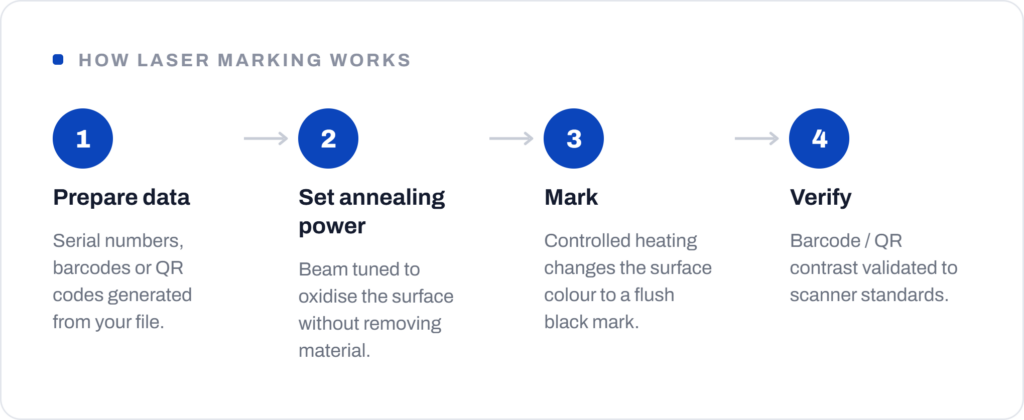
Because no material is removed, the marked surface remains completely flat. This makes annealing the preferred method for applications where scanner compliance is required. Barcodes and QR codes marked by annealing pass standard barcode verification at the highest grades because there is no raised or recessed profile to cause a reflection artefact. It is also the method of choice for medical, food-processing, and pharmaceutical applications where no inks, coatings, or chemical residues can be tolerated.
Laser annealing is inherently a dry, consumable-free process. There is no ink to replenish, no solvent to handle, and no coating to cure, just a laser beam on bare metal. The marks are resistant to sterilisation processes including autoclaving and chemical disinfection, making the process well-suited to surgical instruments, food processing equipment, and pharmaceutical manufacturing components.
Best for Applications that must stay perfectly flat and free of any coating or residue: surgical instruments, food-processing equipment and pharmaceutical components, plus any scanner-critical barcode or QR code. Laser annealing alters the surface colour of metal through controlled oxidation without removing material, giving a rich permanent black on stainless steel and a high-contrast mark on anodised aluminium. Because there is no raised or recessed profile to create reflection artefacts, annealed codes pass barcode verification at the highest grades, and the marks resist sterilisation including autoclaving and chemical disinfection. Suitability for your specific alloy and application is best confirmed with us.
When it's cost-effective Across a wide range of run sizes, because it is an inherently dry, consumable-free process: no ink to replenish, no solvent to handle and no coating to cure, just the laser on bare metal. With no screens, plates or tooling there is no setup cost to pay off, and serialised or variable marks add nothing to the price. It is most economical to specify where its flat, residue-free finish or sterilisation resistance is genuinely required, since a faster method may suit purely cosmetic marking. Tell us your throughput and material and we will advise.
Commonly used materials in laser marking are Stainless Steel, Anodised Aluminium, Titanium and Coated Metals.
Why choose Laser Marking
Surface-flush result
No depth and no burrs, ideal for smooth equipment panels and precision instrument housings
Barcode-ready contrast
High-contrast marks pass 2D scanner validation for barcodes and QR codes in industrial workflows
No coatings applied
Consumable-free and hygienic, no inks or residues, suited to medical and food-processing equipment
Our work
Products we make with Laser Marking
Industries that use Laser Marking
Frequently asked questions
Laser marking alters the surface of a material without removing significant material, typically through oxidation (annealing), colour change, or foaming, while laser engraving physically removes material to create a recessed mark. Laser marking produces a flat, high-contrast mark suitable for barcodes and serialisation; engraving produces a deeper, tactile mark.
Laser marking is most commonly applied to stainless steel, titanium, and anodised aluminium, where the laser creates a permanent black or contrasting mark through controlled oxidation. It is also used on plastics, ceramics, and coated metals where surface marking rather than material removal is required.
Yes. Laser marking produces high-contrast, precisely dimensioned barcodes and QR codes that meet GS1 and ISO 15415 verification standards. The marks are permanent, scannable, and resistant to the cleaning and handling conditions of industrial environments.
Laser marking is widely used in aerospace MRO (part serialisation), pharmaceutical manufacturing (GMP equipment identification), semiconductor and electronics (component traceability), and oil and gas (ATEX equipment marking). Any industry requiring permanent, traceable identification on metal components uses laser marking.
Yes. Because laser annealing changes the surface colour of the metal itself rather than applying an ink or coating, the mark has no film to break down under sterilisation. Marks made this way are typically resistant to autoclaving and chemical disinfection, which is why the process suits surgical instruments and pharmaceutical equipment. Final suitability depends on the substrate and your specific cleaning cycle.
Ready to start a Laser Marking job?
Attach your artwork or drawing and we'll quote the process, material and turnaround for your project.
Get a quote