Laser Etching
High-speed laser etching for production-line serial numbers, barcodes, and batch marks, fast throughput with no tooling and no mechanical contact.
What is Laser Etching?
Laser etching is a high-speed laser marking process that melts and slightly raises the material surface rather than removing it as deep engraving does. The result is a permanent, high-contrast mark produced significantly faster than deep engraving, making it the preferred method for production-line serial number application, batch coding, and traceability marking where throughput matters as much as durability.
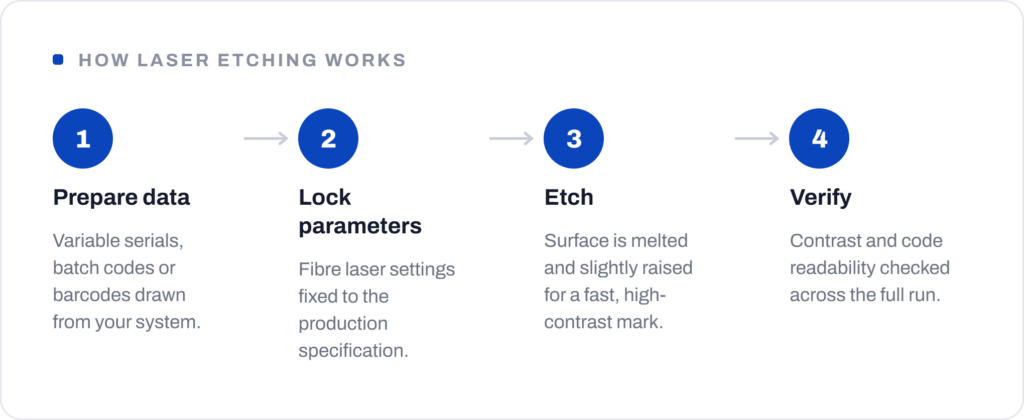
The process works well on a wide range of metals and coated surfaces. On painted or powder-coated panels, the laser removes the coating to expose the base material, creating a two-tone mark. On bare metals, the melt-and-resolidify cycle produces a mark that is visually distinct from the surrounding surface and highly resistant to abrasion and chemical exposure. Etched barcodes and Data Matrix codes reliably meet traceability standards including ISO/IEC 15415 and AIM DPM when produced on the correct substrate.
Because there is no tooling contact, laser etching introduces no mechanical stress to the part, an important consideration for precision components, thin-wall structures, or assemblies where dimensional stability must be maintained. We work from your supplied data files and can integrate with your production data system for fully variable serial number or batch mark generation.
Best for High-throughput production marking where speed matters as much as durability: production-line serial numbers, batch codes and traceability marks. Etching melts and slightly raises the surface rather than cutting deep, so it produces a permanent, high-contrast mark significantly faster than deep engraving. It works well on a range of metals and coated surfaces, lifting paint or powder coat to give a two-tone mark, and because there is no tooling contact it adds no mechanical stress, which matters for precision components, thin walls and dimensionally sensitive assemblies. Etched barcodes and Data Matrix codes can meet traceability standards including ISO/IEC 15415 and AIM DPM when produced on the correct substrate.
When it's cost-effective Medium to high volumes of the same or serialised mark, where its speed advantage over deep engraving lowers the per-unit time and cost the most. Like other laser processes it needs no screens, plates or tooling, so there is no setup cost to amortise and variable data such as serial numbers or batch codes is generated at no extra charge. For very short runs the cost difference against slower laser engraving is small, so choose etching mainly where throughput is the deciding factor. We can integrate with your production data system for fully variable marking.
Commonly used materials in laser etching are Stainless Steel, Aluminium, Powder-coated Surfaces and Coated Metals.
Why choose Laser Etching
High throughput
Faster cycle times than deep engraving, suited to production-line marking of serial numbers and barcodes
Good contrast
Melted surface creates visible, high-contrast marks on most metals and powder-coated components
Repeatable quality
Fibre laser parameters locked to production specification, consistent output across the full run
Our work
Products we make with Laser Etching
Frequently asked questions
Laser etching melts and raises the material surface to create a mark, rather than removing material as in engraving. The result is a slightly raised, high-contrast mark achieved faster and at lower power than deep engraving. It is ideal for serialisation and identification marks where speed and contrast matter more than depth.
Laser etching is applied to metals including stainless steel, aluminium, and titanium, as well as ceramics and some plastics. It is particularly effective on bare metals where the surface melt creates a contrasting mark without the need for coatings or inks.
Yes. Laser etching creates a permanent surface modification that cannot be removed by cleaning, chemicals, or normal abrasion. The mark is part of the material surface rather than an applied coating, making it suitable for lifetime-of-equipment identification requirements.
Laser etching is commonly used for equipment serialisation, tool identification, medical device marking, and component traceability in aerospace, semiconductor, and pharmaceutical manufacturing. It is preferred where high throughput is required alongside permanent, verifiable marks.
Yes. Laser etching is well suited to serialisation, with each part carrying a unique serial number, barcode, or Data Matrix code driven from your data file. This makes it a common choice for production-line traceability where every item needs individual identification.
Ready to start a Laser Etching job?
Attach your artwork or drawing and we'll quote the process, material and turnaround for your project.
Get a quote