Chemical Etching
Photochemical etching for fine detail, intricate patterns, and precision components where heat or mechanical stress cannot be tolerated.
What is Chemical Etching?
Photochemical etching uses a photographic masking process to protect selected areas of a metal sheet while an etchant solution removes the exposed material. The result is a burr-free, stress-free, dimensionally precise surface mark achieved entirely without heat, mechanical force, or cutting tools. At Million, photochemical etching is used for precision instrument faces, rating plates, decorative panels, and identification plates where fine detail and a clean, flat surface finish are required.
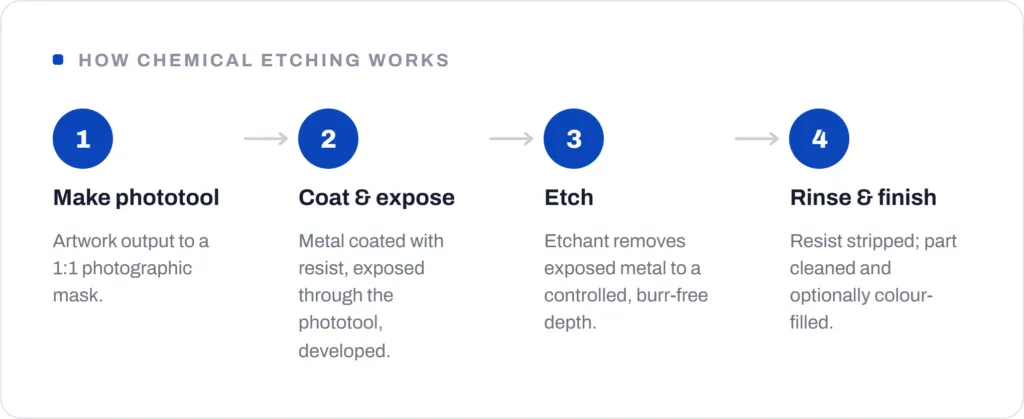
The process begins with a phototool created from your artwork at exact 1:1 scale. The metal sheet is coated with photosensitive resist, exposed through the phototool, developed, and etched in a controlled bath. Etch depth is controlled by time and temperature, allowing single-surface etching for decorative applications and multiple etch depths on the same part, half-etching for background areas and full etching for fine lines, in a single production run.
Because no mechanical force is applied at any stage, photochemical etching introduces no heat-affected zones, no residual stress, and no work-hardening. This makes it suitable for hard metals including spring steel and beryllium copper, and for thin materials where mechanical processes would cause distortion. Materials we regularly etch include stainless steel, mild steel, aluminium, brass, copper, nickel silver, and titanium.
Best for Fine-detail, flat, dimensionally precise metal parts that cannot tolerate heat or mechanical stress: precision instrument faces, rating plates, decorative panels and identification plates. The photographic mask-and-etch process is burr-free, stress-free and introduces no heat-affected zones or work-hardening, which makes it suitable for hard metals such as spring steel and beryllium copper and for thin materials that mechanical processes would distort. Multiple etch depths, including half-etching for backgrounds alongside full etching for fine lines, are produced in a single run. Materials regularly etched include stainless steel, mild steel, aluminium, brass, copper, nickel silver and titanium, with metal from 0.01mm to 1.5mm thick on sheets up to 600 x 1500mm.
When it's cost-effective Medium to long runs, and sheets ganged with many parts at once, because the main setup cost is the one-off phototool. Once that phototool exists, every part on the sheet etches in the same bath at the same time, so the per-unit cost falls sharply as quantity rises and as more parts are nested per sheet. For a single part or a very short run the phototool cost dominates, so a digital method such as laser marking or engraving is usually more economical at low volumes. Tell us your quantity and part size and we will advise on the crossover.
Commonly used materials in chemical etching are Stainless Steel, Aluminium, Brass, Copper, Nickel and Titanium.
Why choose Chemical Etching
No mechanical stress
No cutting forces applied, ideal for fragile, thin, or stress-sensitive components
Fine detail
Sub-millimetre features and fine text reproduced accurately with burr-free edges
Uniform etch depth
Controlled chemistry produces consistent depth across the entire sheet, critical for rating plates and instrument faces
Our work
Products we make with Chemical Etching
Industries that use Chemical Etching
Frequently asked questions
Chemical etching (also called photo etching or acid etching) uses a photoresist mask and chemical etchant to selectively dissolve metal from a substrate surface, producing precise, flat marks or cut-through parts. The process can achieve very fine detail, tolerances of ±0.025mm, making it suitable for complex patterns and small text on metal.
Chemical etching works on stainless steel, aluminium, brass, copper, titanium, nickel alloys, and most engineering metals. The etchant chemistry is selected based on the specific metal: ferric chloride for copper and brass, sodium hydroxide for aluminium, and nitric or hydrochloric acid blends for stainless steel.
Chemical etching produces a completely flat, stress-free mark without the heat-affected zone of laser processing. It can etch very fine features across large panel areas simultaneously, making it cost-effective for complex, high-detail work. It is preferred for decorative metalwork, precision identification plates, and applications where surface integrity must be maintained.
Yes. Chemically etched stainless steel nameplates are commonly used on equipment in ATEX, marine and offshore, and pharmaceutical (GMP) environments because the etch mark is integral to the metal surface. It cannot be obscured, filled, or degraded by the exposure conditions. Final compliance depends on the equipment marking requirements.
Yes. Because etching produces a recessed mark, the recess can be paint- or enamel-filled to give a high-contrast, colour-fast finish that sits flush with the surrounding metal. This is common on rating plates and instrument faces where legibility matters. The infill is protected within the etched recess, so it resists abrasion better than a surface print.
Ready to start a Chemical Etching job?
Attach your artwork or drawing and we'll quote the process, material and turnaround for your project.
Get a quote