
CNC Routing
CNC routing for precision cutting, profiling, and pocketing of thick sheet materials: handles depths and substrates that laser cutting cannot reach.
What is CNC Routing?
CNC routing uses a computer-controlled milling spindle to cut, profile, pocket, and shape sheet materials in two and three dimensions. It is the primary process for any marking or display application that requires cutting through thick materials, machining shaped pockets, or producing three-dimensional forms, tasks that are beyond the depth or power capacity of laser cutting. At Million, our CNC router processes sheets up to 2400×1200mm directly from DXF or CAD files, with material thicknesses from 1mm to over 50mm depending on the substrate.
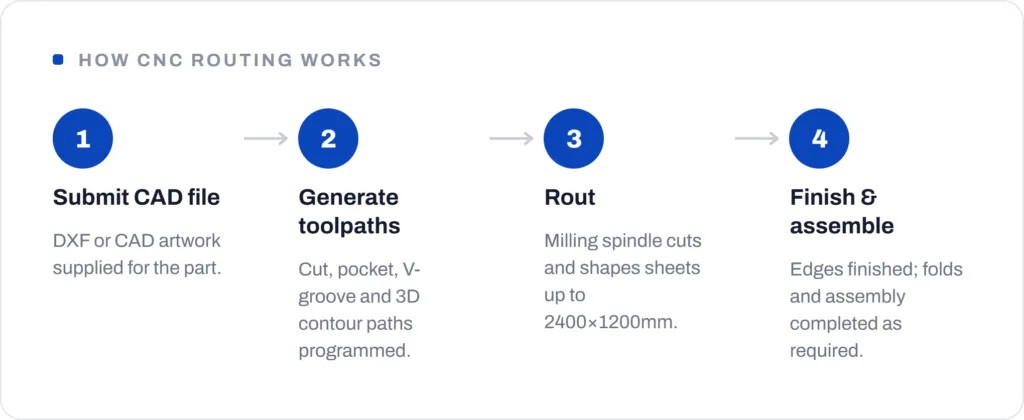
Common applications include dimensional acrylic letters for signage, shaped display stands and pedestals, routed timber and MDF panels for exhibition graphics, and aluminium fabrications for industrial enclosures and brackets. V-grooving, routing a V-shaped channel that allows the sheet to be folded to a precise angle, is used extensively in acrylic fabrication for display cases, menu holders, and custom enclosures. Pocket routing creates recesses for inlaid panels, embedded hardware, and flush-mounted components.
CNC routing is compatible with acrylic, polycarbonate, aluminium, MDF, plywood, solid timber, PVC foam board, and most composite sheet materials. Because the process is numerically controlled, complex profiles are as straightforward to produce as simple rectangles, and repeat orders are reproduced identically from the saved program. We work closely with designers and fabricators who need cut parts produced to tight tolerances as part of a larger assembly.
Best for Cutting, profiling, pocketing and 3D shaping of thick sheet material that is beyond the depth or power of laser cutting: dimensional acrylic letters, shaped display stands and pedestals, routed timber and MDF exhibition panels, and aluminium fabrications for enclosures and brackets. V-grooving lets a sheet be folded to a precise angle for display cases and enclosures, and pocket routing creates recesses for inlaid panels and flush-mounted hardware. It handles acrylic, polycarbonate, aluminium, MDF, plywood, solid timber, PVC foam board and most composites, with sheets up to 2400 x 1200mm and thicknesses from 1mm to over 50mm depending on substrate.
When it's cost-effective Any quantity from one-offs upward, because it is numerically controlled with no hard tooling: complex profiles are as straightforward to produce as simple rectangles, and repeat orders reproduce identically from the saved program at no re-setup cost. As with any cut-to-order process, short runs carry a higher per-unit cost because the programming and machine-setup time is shared across fewer parts. It is the economical choice specifically where thickness, pocketing or 3D form rules out laser cutting; where a thin flat profile would do, laser cutting may be faster and cheaper.
Commonly used materials in cnc routing are Acrylic, PVC, Aluminium Composite, Foam Board, MDF, Timber and HDPE.
Why choose CNC Routing
Large format capacity
Handles sheets up to 2400x1200mm, suitable for full-size signage panels and large display structures
Deep and profiled cuts
V-grooves, pockets, and 3D contouring available, operations that laser cutting cannot perform
Direct from CAD
Toolpaths generated from DXF or CAD files, no manual setup or hard tooling required
Our work
Products we make with CNC Routing
Industries that use CNC Routing
Frequently asked questions
CNC routing uses a computer-controlled rotating cutting tool to cut, shape, or engrave materials with high precision. It works on acrylic, aluminium, wood, MDF, PVC, foam, composite panels, and most engineering plastics, making it the preferred process for cutting shaped nameplates, signage panels, and custom parts from sheet material.
CNC routing typically achieves tolerances of ±0.1–0.25mm for cutting operations and ±0.1mm for engraving, depending on material, tool diameter, and feed rate. For tighter tolerances on metal parts, chemical etching or laser cutting may be more appropriate.
CNC routing uses a physical cutting tool (router bit) and produces a wider kerf than laser cutting, typically 2–6mm versus 0.1–0.3mm for laser. CNC routing is better suited to thicker materials (above 10mm), materials that produce harmful fumes when laser-cut, and applications requiring a machined edge finish. Laser cutting is preferred for thin materials and intricate detail.
Yes. CNC routing is commonly used to cut shaped aluminium and acrylic nameplates and signs with profiled edges, rounded corners, and cutouts. The process can combine cutting and engraving in a single operation, cutting the panel to shape while simultaneously engraving the text or graphics.
CNC routing handles full sheets and thicker stock than laser cutting can process, covering materials from thin sheet up to substantial thicknesses depending on the substrate. Larger panels can often be produced by nesting or by machining in sections.
Ready to start a CNC Routing job?
Attach your artwork or drawing and we'll quote the process, material and turnaround for your project.
Get a quote