Waterjet Cutting
Waterjet cutting for materials where heat cannot be used, thick metals, stone, ceramics, and composites cut with no heat-affected zone and no warping.
What is Waterjet Cutting?
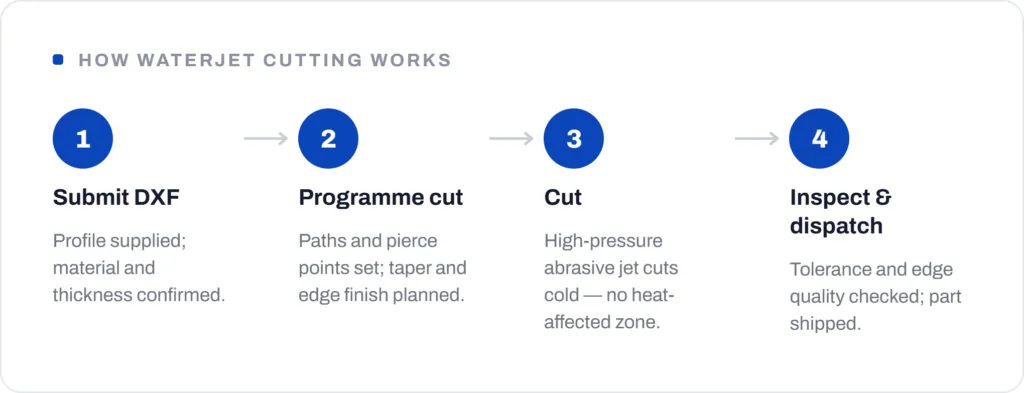
Waterjet cutting uses a high-pressure stream of water, mixed with abrasive garnet for hard materials, to cut through virtually any material without generating heat. Because the process is entirely cold, there are no heat-affected zones, no material hardening, no warping, and no change to the material properties at or near the cut edge. This makes waterjet cutting essential for applications where heat-based cutting methods would compromise the material or the finished part.
At Million, waterjet cutting is used for thick metals, natural stone, ceramics, composites, and laminated materials that cannot be processed by laser or plasma. Cut accuracy of ±0.1mm is achievable on most materials, and the cold cutting action produces a smooth edge finish that often requires minimal secondary processing. Internal profiles, holes, slots, and complex internal cutouts, are machined by piercing the material directly, without the need for a pre-drilled start hole in most cases.
Material thickness capacity ranges from 1mm up to 100mm or more depending on the material and the required edge quality. Common applications include shaped stone panels for architectural and memorial work, thick aluminium and steel structural components, ceramic and glass tile cutting for custom installations, and fibre-composite cutting where the delamination risk of mechanical sawing makes waterjet the only viable option. We work from DXF files and can advise on material-specific considerations including taper angle, edge finish, and tolerancing before production.
Best for Cutting thick or heat-sensitive materials that laser or plasma would compromise: thick metals, natural stone, ceramics, composites and laminated materials. The cut is entirely cold, so there are no heat-affected zones, no material hardening, no warping and no change to material properties at the cut edge, and the smooth finish often needs minimal secondary work. Internal profiles, holes and slots are pierced directly without a pre-drilled start hole in most cases. Accuracy of about 0.1mm is achievable on most materials, and thickness capacity ranges from 1mm up to 100mm or more depending on material and required edge quality.
When it's cost-effective It is programmed directly from a DXF file with no hard tooling, so any quantity including one-offs can be produced without a tooling charge, and complex internal profiles cost no more to program than simple shapes. As with other cut-to-order processes, short runs carry a higher per-unit cost because setup time is shared across fewer parts, and cutting is slower on very thick or very hard material, which affects price. It is the economical choice specifically where heat sensitivity, thickness or material type rules out laser; for thin materials a laser cut is usually faster and cheaper. We will advise at quoting.
Commonly used materials in waterjet cutting are Stainless Steel, Aluminium, Brass, Mild Steel, Marble, Granite, Glass, Rubber, Composites and Thick Acrylic.
Why choose Waterjet Cutting
No heat-affected zone
Cold-cutting process preserves material properties, no warping, hardening, or thermal distortion
Cuts virtually any material
Metals, stone, glass, ceramics, composites, rubber: if it is flat, waterjet can cut it
Heavy gauge capacity
Cuts from 1mm up to 100mm+ thick, beyond the range of most laser and router systems
Our work
Frequently asked questions
Waterjet cutting uses a high-pressure jet of water, typically mixed with an abrasive garnet, to cut through materials without heat. Because there is no heat-affected zone, the material properties at the cut edge are preserved, making waterjet the preferred method for heat-sensitive materials, thick metals, and applications requiring no material distortion.
Waterjet cutting works on virtually any material: stainless steel, aluminium, titanium, glass, stone, ceramic, carbon fibre, rubber, foam, and composites. Materials that cannot be laser or plasma cut, including reflective metals, stone, glass, and multi-layer composites, are routinely processed by waterjet.
Waterjet cutting can handle materials from 1mm up to 200mm+ in thickness, depending on material type. Cutting speed decreases with thickness, but unlike laser cutting there is no practical upper limit on most materials. Stainless steel up to 100mm and stone slabs are common applications.
Waterjet cutting achieves tolerances of ±0.1–0.5mm depending on material thickness and complexity. For precision parts, tolerances of ±0.1mm are achievable on thin, flat materials. Edge quality is influenced by cutting speed. Slower speeds produce smoother, more accurate edges.
We cut from a vector cut-path file, with DXF being the standard for CNC-based waterjet work. Send the DXF along with the material, thickness, and quantity and we can prepare a quote and advise on edge finish and any taper considerations. If you only have a PDF or sketch, we can advise on converting it to a suitable cut file.
Ready to start a Waterjet Cutting job?
Attach your artwork or drawing and we'll quote the process, material and turnaround for your project.
Get a quote