Sandblasting
Sandblasting for frosted, recessed designs on glass, stone, metal, and timber, a tactile, matte finish that printing and laser methods cannot replicate.
What is Sandblasting?
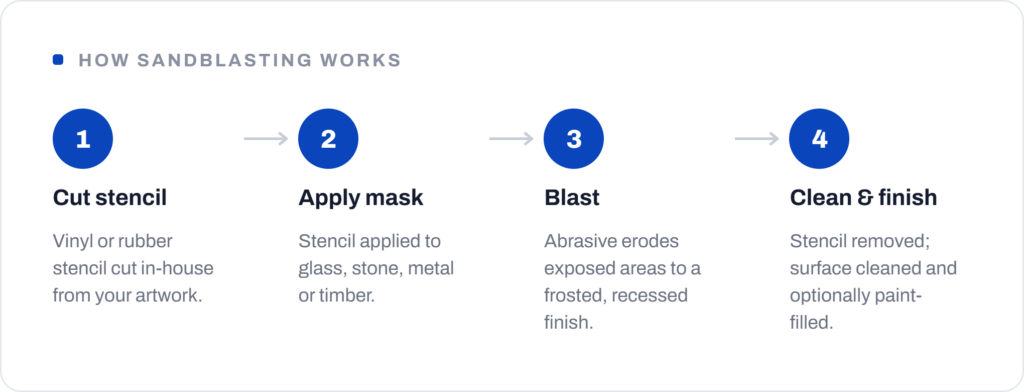
Sandblasting propels abrasive particles at high velocity against the substrate surface, eroding exposed areas to create a frosted, recessed, or textured finish. At Million, sandblasting is used with precision-cut stencils, either vinyl or rubber, to produce sharp-edged frosted designs, lettering, and imagery on glass, stone, timber, and metal. The result is a tactile, matte-finish mark with a depth and visual character that printing and laser processes cannot replicate on these substrates.
Frosted glass signage is one of the most common applications: company logos, room names, and decorative graphics etched into architectural glass panels, doors, and partitions for a premium, permanent result. Unlike a printed vinyl decal, a sandblasted glass panel cannot fade, peel, or be removed without damaging the glass itself. The finish catches light differently from polished glass, creating a subtle visual contrast that works as well in high-end retail environments as it does in corporate offices.
On stone and natural materials, sandblasting produces the deep, recessed lettering used for memorial plaques, building inscription panels, and decorative architectural elements. Blast depth, abrasive grade, and blast pressure are all adjusted to suit the substrate. Stencils are produced in-house from your supplied artwork, and we can advise on design considerations, minimum letter size, stencil bridging, and safe working distances, before production begins.
Best for Tactile, frosted, recessed finishes with a depth and character that printing and laser methods cannot replicate on glass, stone, timber and metal: frosted-glass logos, room names and decorative graphics on architectural panels, doors and partitions, and deep recessed lettering on stone for memorial plaques and building inscriptions. Precision-cut vinyl or rubber stencils give sharp-edged designs, and a sandblasted glass panel cannot fade, peel or be removed without damaging the glass itself. Blast depth, abrasive grade and pressure are all tuned to the substrate, and stencils are produced in-house from your artwork. Minimum letter size and design bridging are best worked out with us before production.
When it's cost-effective The main setup is cutting the stencil, so cost is driven mainly by design size and complexity rather than by long run lengths, which makes it practical for one-off architectural and memorial pieces. Larger quantities of the same design share the stencil-preparation effort and so cost less per piece, though each piece still needs its own blasting time. It is the economical choice specifically where a genuine frosted or recessed finish is wanted on glass or stone; for a similar look at lower cost on flat surfaces, frosted-effect vinyl may be an alternative. We can advise on the best route for your job.
Commonly used materials in sandblasting are Glass, Granite, Marble, Stainless Steel, Aluminium, Timber and Coated Surfaces.
Why choose Sandblasting
Works on stone and glass
The preferred method for frosted glass signage and stone plaques, results that printing cannot achieve
Tactile depth
Recessed marks have natural depth that adds a premium quality to awards, plaques, and architectural features
Stencil-controlled accuracy
Vinyl stencils cut in-house ensure sharp, accurate lettering and logo outlines
Our work
Frequently asked questions
Sandblasting (abrasive blasting) propels fine abrasive particles at high pressure onto a substrate surface, creating a matte, frosted texture. In marking applications, a vinyl stencil protects the areas to remain untouched while the exposed areas are abraded, producing frosted logos, text, or patterns on glass, stone, acrylic, and metal.
Sandblasting is applied to glass, stone, acrylic, anodised aluminium, stainless steel, brass, wood, and concrete. The abrasive media and pressure are adjusted for each material to achieve the required surface texture without damage.
Sandblasting produces a frosted, tactile texture by physically abrading the glass surface, creating a white matte appearance. Laser engraving on glass creates a similar frosted effect through micro-fracturing but with higher edge precision. Sandblasting can cover large areas efficiently; laser is better for fine detail and small text.
Yes. Sandblasting is used to create permanent identification marks on industrial equipment, tools, stone surfaces, and architectural elements where a tactile, embossed mark is preferred. For equipment in harsh environments, sandblasted marks on metal can be filled with paint or enamel for contrast and additional protection.
Sandblasting works through a cut stencil, so very fine lines, small text, and isolated centres of letters need enough width and bridging to hold up during blasting. We can advise on minimum letter size and stencil bridging for your artwork before production. Send your design and target substrate and we will flag anything that needs adjusting.
Ready to start a Sandblasting job?
Attach your artwork or drawing and we'll quote the process, material and turnaround for your project.
Get a quote