
Foam Insert Fabrication
CNC-machined foam inserts for tool kits, instrument cases, and shadow boards: every item has a precise cavity that makes missing pieces immediately visible.
What is Foam Insert Fabrication?
CNC foam cutting uses a computer-controlled blade or hot-wire system to machine precise cavities into foam block, creating custom inserts that hold tools, instruments, or components in exactly the right position. Each cavity is profiled to the exact outline of the item it holds, so every piece has a designated place, and any missing piece leaves an immediately visible gap. This visual accountability is the foundation of 5S workplace organisation and tool control programmes across manufacturing, maintenance, and field service operations.
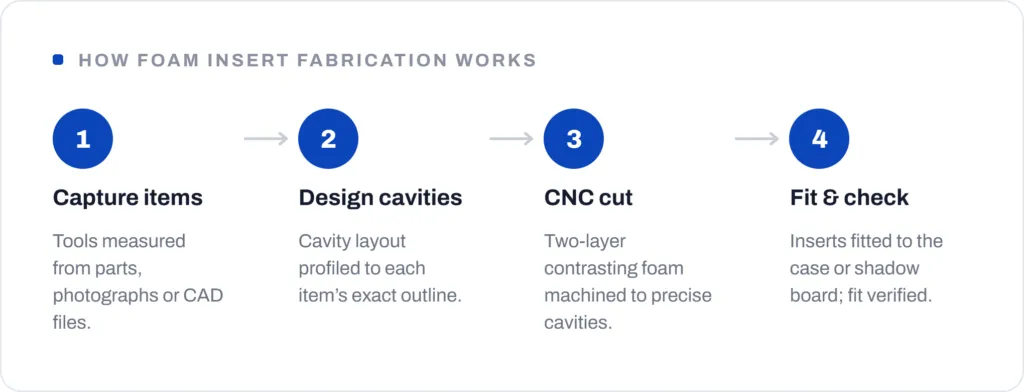
At Million, foam inserts are produced from supplied tools and instruments, from photographs, or from customer-supplied CAD files. The standard approach uses two layers of foam in contrasting colours, typically black over a brighter colour, so that the outline of each cavity is clearly visible as a coloured border, making missing items impossible to overlook even in a cluttered or low-light environment. Multiple foam colours are available for colour-coding by tool type, user, or department.
Applications include tool kits for maintenance technicians, calibration instrument cases for quality and metrology departments, field service kits, surgical instrument trays, and exhibition display cases for products or samples. Shadow boards, vertical panel-mounted versions using the same profiling technology, are produced for workshop walls and tool stores. We supply foam inserts as standalone items for fitting into existing cases, or fabricate complete cases with custom-cut foam as an integrated unit.
Best for Tool control and 5S visual management, where every item needs a designated place and any missing piece must be immediately obvious: maintenance tool kits, calibration and metrology instrument cases, field-service kits, surgical instrument trays, shadow boards for workshop walls and exhibition display cases. Each cavity is profiled to the exact outline of the item it holds, and a two-layer contrasting foam, typically black over a brighter colour, frames every cavity with a coloured border so gaps stand out even in cluttered or low-light conditions. Inserts are produced from supplied tools, from photographs or from CAD files, with multiple foam colours for coding by tool type, user or department.
When it's cost-effective Cost is driven mainly by the design and profiling of the cavity layout rather than by run length, since the layout is the main one-off effort. A single custom insert or case is therefore practical to produce, and repeat sets of the same layout become more economical per unit once the profiling program is set. Working from supplied tools, drawings or photographs keeps the design step efficient, and inserts can be supplied standalone for existing cases or built into a complete case as one unit. Tell us your case and tools and we will advise on the approach.
Commonly used materials in foam insert fabrication are High-density Polyethylene (HDPE) Foam, Polyurethane Foam, EVA Foam and Closed-cell Foam.
Why choose Foam Insert Fabrication
Tool accountability
Missing tools are immediately visible at a glance, essential for safety-critical maintenance environments
CNC precision
Cavities cut to exact tool profiles, secure fit with no movement or damage during transport
Multiple foam options
HDPE, polyurethane, and EVA foam in multiple colours for visual management and 5S compliance
Our work
Frequently asked questions
Foam insert fabrication involves cutting precision cavities into foam (typically polyethylene or EVA foam) to hold specific tools, instruments, or equipment securely. Used in tool control, 5S workplace organisation, equipment cases, and presentation packaging: foam inserts ensure every item has a designated place and missing items are immediately visible.
We work primarily with closed-cell polyethylene foam and cross-linked EVA foam, available in a range of densities and colours. High-density foam provides firm tool retention; lower-density foam offers cushioning for delicate instruments. Colour-coding (red for high-risk tools, black for standard) is standard in aerospace and defence tool control applications.
A 5S tool shadow board displays tools on a vertical board with foam inserts or painted outlines showing the exact position of each tool. When a tool is removed, the empty cavity is immediately visible, supporting the 5S methodology by making it impossible to miss a missing tool. This is standard practice in manufacturing, MRO, and food processing facilities.
Aerospace and aviation MRO have strict tool control requirements (FOD prevention) mandating that every tool is accounted for before and after maintenance. Food and beverage manufacturing uses colour-coded foam inserts to prevent foreign object contamination. General manufacturing and 5S programmes use foam inserts for workplace organisation and tool accountability.
We can produce cavities from the supplied tools or instruments, from clear photographs with a scale reference, or from customer-supplied CAD files. Sending the actual items gives the most precise fit, but drawings or photos work well where tools cannot be released.
Ready to start a Foam Insert Fabrication job?
Attach your artwork or drawing and we'll quote the process, material and turnaround for your project.
Get a quote