Dye Sublimation Printing
Dye sublimation permanently embeds photographic-quality full-colour images into the substrate surface, no surface film, no peeling, no fading.
What is Dye Sublimation Printing?
Dye sublimation is a printing process in which dye is transferred from a carrier film into the substrate surface under heat and pressure, permanently embedding the colour molecules within the material itself rather than depositing them on top. The result is a print with no surface film, no raised texture, and no edge to lift, peel, or scratch. Colours are photographic in quality and remain stable under UV exposure, abrasion, and most chemical cleaning agents because the dye is protected by the substrate material above it.
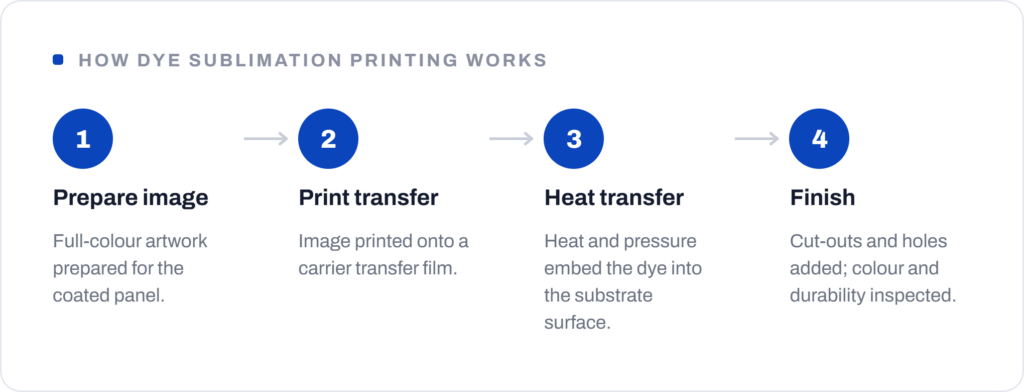
At Million, we use dye sublimation primarily on aluminium panels (up to 279 × 432 mm / 11 × 17 inch) with a specialised sublimation coating, producing graphics that combine the durability and dimensional stability of aluminium with the full-colour reproduction of a photographic print. This combination is widely used for premium nameplates, corporate awards, commemorative plaques, and branded merchandise where visual quality and long service life are both required.
The process is digital and plate-free, so short runs are as cost-effective as long ones, and personalised items, individual names, photographs, or unique data on every piece, are produced at no additional cost. We can print to substrates supplied by the customer or work from our own material stock, and we can incorporate cut-outs, drilled mounting holes, and shaped edges as part of the same production process.
Best for Premium, photographic-quality full-colour graphics that must survive without any surface film to lift, peel or scratch: premium nameplates, corporate awards, commemorative plaques and branded merchandise. The dye is embedded into the substrate under heat and pressure, so colour becomes part of the material and stays stable under UV, abrasion and most chemical cleaning. Million uses it primarily on specially coated aluminium panels, combining the durability of aluminium with photographic reproduction. It is a small-format process with a maximum print size of 279 x 432mm (11 x 17 inch), and cut-outs, drilled holes and shaped edges can be incorporated in the same run.
When it's cost-effective The process is digital and plate-free, so short runs are as cost-effective as long ones and there is no setup cost to pay off. Personalised items, individual names, photographs or unique data on every piece, are produced at no additional cost, which makes it well-suited to award and nameplate work where each unit differs. For large volumes of a single fixed design on flat metal, screen printing may lower the per-unit cost, and note the small maximum panel size means larger pieces need a different process. Tell us your size and quantity and we will advise.
Commonly used materials in dye sublimation printing are Polyester-coated Aluminium, Polyester Fabric and Ceramic-coated Substrates.
Why choose Dye Sublimation Printing
Embedded image
Ink bonds into the coating surface, no surface film to peel, scratch, or delaminate in service
Photographic quality
Full-colour gradients and photography reproduced accurately on aluminium nameplate panels
Excellent durability
Fade-resistant and scratch-resistant, suitable for outdoor signage and long-life industrial identification
Our work
Frequently asked questions
Dye sublimation printing transfers dye into the surface of a substrate using heat and pressure, producing vibrant, photographic-quality images that are part of the material rather than sitting on top. It is used for custom nameplates, badges, awards, signage, and branded merchandise requiring full-colour, durable marking.
Dye sublimation works best on polyester-coated metals (aluminium), polyester fabrics, and polymer-based substrates. The substrate must have a polyester coating or be polymer-based to accept the dye during the heat transfer process. Standard metals, glass, or wood cannot be dye sublimated directly without a polyester coating.
Because the dye penetrates into the substrate surface rather than sitting on top, dye sublimation marks are scratch-resistant, UV-stable, and washable. On coated aluminium, the marks can last 10+ years without fading, significantly more durable than surface-applied inkjet or screen prints.
Yes. Dye sublimation on UV-stable aluminium panels produces outdoor signage that resists UV fading, moisture, and temperature variation. It is commonly used for outdoor building signage, wayfinding panels, and vehicle graphics where full-colour, long-life marking is required.
Yes. The process is fully digital with no plates or screens, so personalising every piece with an individual name, photograph, or unique data adds no tooling cost. This makes it well suited to award sets, commemorative plaques, and badges where each item differs.
Ready to start a Dye Sublimation Printing job?
Attach your artwork or drawing and we'll quote the process, material and turnaround for your project.
Get a quote